Staying on top of ATO tax deadlines in 2026 is essential for Australian businesses of all sizes. Income tax lodgement, BAS reporting, PAYG withholding, payroll tax, and superannuation all operate under strict statutory due dates. Missing even one obligation can trigger penalties, interest, and cash flow stress. This guide explains official 2026 deadlines, reporting cycles, and compliance rules, helping businesses plan payments confidently and meet ATO requirements without last-minute pressure while improving forecasting accuracy and year-round discipline.
What are the ATO Tax Deadlines for 2026?
ATO tax deadlines 2026 refer to the official lodgement and payment due dates set by the Australian Taxation Office (ATO) for the 2025–26 financial year and related reporting periods.
According to the ATO’s official key dates calendar, Australian businesses must meet strict deadlines for income tax returns, Business Activity Statements (BAS), PAYG instalments, and superannuation guarantee contributions. Missing these deadlines can result in Failure to Lodge penalties and General Interest Charges.
The Australian financial year runs from 1 July to 30 June. For the 2026 tax cycle, this means:
- Income earned between 1 July 2025 and 30 June 2026 is generally reported in 2026–27.
- BAS, PAYG and super obligations are typically reported monthly or quarterly.
- Company and trust returns may have later due dates depending on the structure and tax agent involvement.
Note: Businesses should confirm exact dates each year as the ATO may adjust deadlines if they fall on weekends or public holidays.
Key ATO Tax Deadlines 2026 Overview
Understanding reporting frequency is the first step toward compliance. The main categories of ATO tax deadlines 2026 fall into monthly, quarterly, annual, and employer-specific obligations.
Monthly Deadlines
Monthly obligations typically apply to:
- Large withholders for PAYG withholding
- Monthly BAS reporters
- Monthly Payroll tax deadlines (state-based)
- Single Touch Payroll (STP) reporting per pay cycle
The ATO confirms that monthly activity statements are generally due on the 21st of the following month.
Quarterly Deadlines
Quarterly reporting is common for small to medium businesses and includes:
- BAS lodgement due dates
- PAYG instalment deadlines 2026
- Quarterly super guarantee payments
Quarterly BAS is usually due on 28 October, 28 February, 28 April and 28 July unless lodging through a tax agent.
Annual Deadlines
Annual obligations include:
- Income tax lodgement 2026
- Company tax return deadlines
- Payroll tax annual reconciliation (state-based)
Most self-lodged individual returns are due 31 October 2026.
Employer-Specific Deadlines
Employers must manage:
- PAYG withholding
- STP finalisation declarations
- Superannuation deadlines 2026
The ATO’s super guarantee guidance confirms quarterly due dates on 28 October, 28 January, 28 April and 28 July.
Income Tax Lodgement 2026
Individual Income Tax Return Deadlines
For individuals lodging their own returns, the ATO states that returns are generally due by 31 October following the end of the financial year. For the 2025–26 financial year, this means 31 October 2026.
Sole Trader Income Tax Deadlines
Sole traders report business income within their individual return. Therefore, Income tax lodgement 2026 for sole traders follows the same 31 October 2026 deadline unless lodged through a registered tax agent.
Lodgement via Tax Agent vs Self-Lodgement
According to the ATO’s lodgement program guidelines, businesses using a registered tax agent before 31 October may access extended deadlines under the tax agent lodgement program.
Payment Due Dates and Extensions
Payment due dates may differ from lodgement dates. The ATO confirms that tax liabilities are often payable by the same date as lodgement unless otherwise specified. Businesses experiencing hardship can request payment plans via the ATO’s online services.
Failure to pay on time may trigger General Interest Charges under Division 8A of the Taxation Administration Act.
Additional guidance: The ATO advises that payment is generally due by the original due date unless a formal arrangement is approved. Businesses experiencing financial difficulty can request payment plans via the ATO’s support services.
Company Tax Return Deadlines 2026
Standard Company Lodgement Dates
Standard balancing companies with a 30 June year-end generally lodge by 28 February or 15 May 2027 if using a tax agent, depending on prior compliance history.
Early and Late Balancer Companies
Companies with substituted accounting periods have different due dates. Lodgement timing depends on the approved balancing date.
Tax Agent Lodgement Concessions
Under the ATO lodgement program, compliant companies using registered agents may receive concessional due dates. However, late prior-year lodgements can remove access to concessions.
Payment Deadlines for Companies
Company tax return is typically payable on the first day of the sixth month after year-end for large and medium entities, though smaller entities often align payment with lodgement. The ATO provides specific payment schedules based on entity size and turnover.
Specific payment dates by entity size:
- Large and medium companies: 1 December
- Small companies (base rate entities): 1 March
These dates are confirmed in ATO company tax guidance. Professional bodies such as Chartered Accountants Australia emphasise proactive tax planning before year-end to avoid unexpected liabilities.
BAS Lodgement Due Dates 2026
Monthly BAS Deadlines
Businesses reporting GST monthly must lodge by the 21st of the following month. This aligns with official ATO activity statement rules.
For example, the July 2026 BAS is due on 21 August 2026.
Quarterly BAS Deadlines
For most small businesses, BAS lodgement due dates in 2026 follow:
| Quarter | Period | Due Date |
| Q1 | Jul–Sep | 28 October 2026 |
| Q2 | Oct–Dec | 28 February 2027 |
| Q3 | Jan–Mar | 28 April 2027 |
| Q4 | Apr–Jun | 28 July 2027 |
These dates are confirmed in the ATO’s BAS calendar.
Annual BAS Reporting
Some small businesses voluntarily register for the GST and report annually. Annual GST returns are typically due by 31 October.
BAS Payment Due Dates
Payment is generally due on the same date as lodgement. Electronic lodgement through a BAS agent may allow minor extensions.
Extensions and Concessions
The ATO may grant deferrals in cases of natural disaster or serious hardship. The Australian Small Business and Family Enterprise Ombudsman notes that early engagement with the ATO significantly improves the likelihood of flexible arrangements.
PAYG Instalment Deadlines 2026
Quarterly PAYG Instalments
Most small and medium businesses pay quarterly instalments. The PAYG instalment deadlines 2026 align with quarterly BAS due dates:
- 28 October
- 28 February
- 28 April
- 28 July
Monthly PAYG Instalments
Large entities may pay monthly instalments, generally due on the 21st of the following month.
Variation Rules and Key Dates
Businesses can vary instalments if income changes significantly. However, the ATO warns that excessive underestimation may trigger penalties. Professional advice is recommended before varying amounts late in the financial year.
Important: Variations must be lodged by the instalment due date.
Payroll Tax Deadlines 2026
Unlike federal taxes, Payroll tax deadlines are set by states and territories.
Monthly Payroll Tax Due Dates
Most states require monthly lodgement and payment by the 7th or 21st of the following month.
Annual Reconciliation Deadlines
Annual payroll tax reconciliation is typically due in July following the end of the financial year.
For example:
- Revenue NSW confirms annual reconciliation due 28 July.
- State Revenue Office Victoria outlines similar July deadlines.
Victoria-specific: State Revenue Office Victoria confirms monthly returns due 7 days after the month-end. Annual reconciliation is generally due 21 July following the financial year end.
State-Based Differences Across Australia
Thresholds and rates vary significantly between states. Businesses operating across jurisdictions must register separately.
Common Payroll Compliance Mistakes
Common issues include:
- Failing to include contractor payments where required
- Missing grouping provisions
- Incorrect threshold calculations
State revenue authorities publish detailed guidance to prevent misclassification errors.
Superannuation Deadlines 2026
Quarterly Super Guarantee Due Dates
The Australian Taxation Office confirms the following Superannuation Guarantee payment deadlines for quarterly periods:
- Quarter 1 (July to September 2025): Super must be paid by 28 October 2025.
- Quarter 2 (October to December 2025): Super must be paid by 28 January 2026.
- Quarter 3 (January to March 2026): Super must be paid by 28 April 2026.
- Quarter 4 (April to June 2026): Super must be paid by 28 July 2026.
These dates apply to all employers paying Super Guarantee contributions quarterly. Missing a deadline can result in penalties and interest, so it is important to schedule payments ahead of time. Late payments attract the Super Guarantee Charge (SGC).
Super Guarantee Charge Deadlines
If SG is unpaid by the quarterly deadline, employers must lodge an SGC statement and pay by the 28th of the second month after the quarter.
End-of-Year Super Reporting
Single Touch Payroll finalisation declarations are generally due by 14 July each year.
Consequences of Late Super Payments
The ATO states that SGC includes interest and administrative fees and is not tax-deductible. Persistent non-compliance may lead to Director Penalty Notices. Super obligations are strictly enforced under the Superannuation Guarantee (Administration) Act.
Important End-of-Financial-Year (EOFY) Deadlines 2026
30 June 2026 Key Cut-Off Dates
Key EOFY 2026 cut-offs include:
- Super contributions must be received by the funds before 30 June to claim deductions.
- Asset purchases must be installed and ready for use to qualify for depreciation.
- Paying deductible expenses
- Writing off eligible assets
Record-Keeping Requirements
The ATO requires most records be retained for at least five years.
Final PAYG and Super Obligations
Employers must finalise STP and ensure all super is paid before deadlines to avoid SGC exposure.
ATO Penalties for Missing Tax Deadlines
Failure to Lodge (FTL) Penalties
The ATO calculates failure-to-lodge penalties for each 28-day period overdue, up to a statutory cap.
General Interest Charge (GIC)
The ATO applies GIC daily on outstanding amounts, with rates updated quarterly.
Director Penalty Notices
Directors can become personally liable for unpaid PAYG withholding and superannuation under Director Penalty Notice rules.
How to Request Remission
The ATO may remit penalties where businesses demonstrate reasonable cause. Early engagement is strongly recommended.
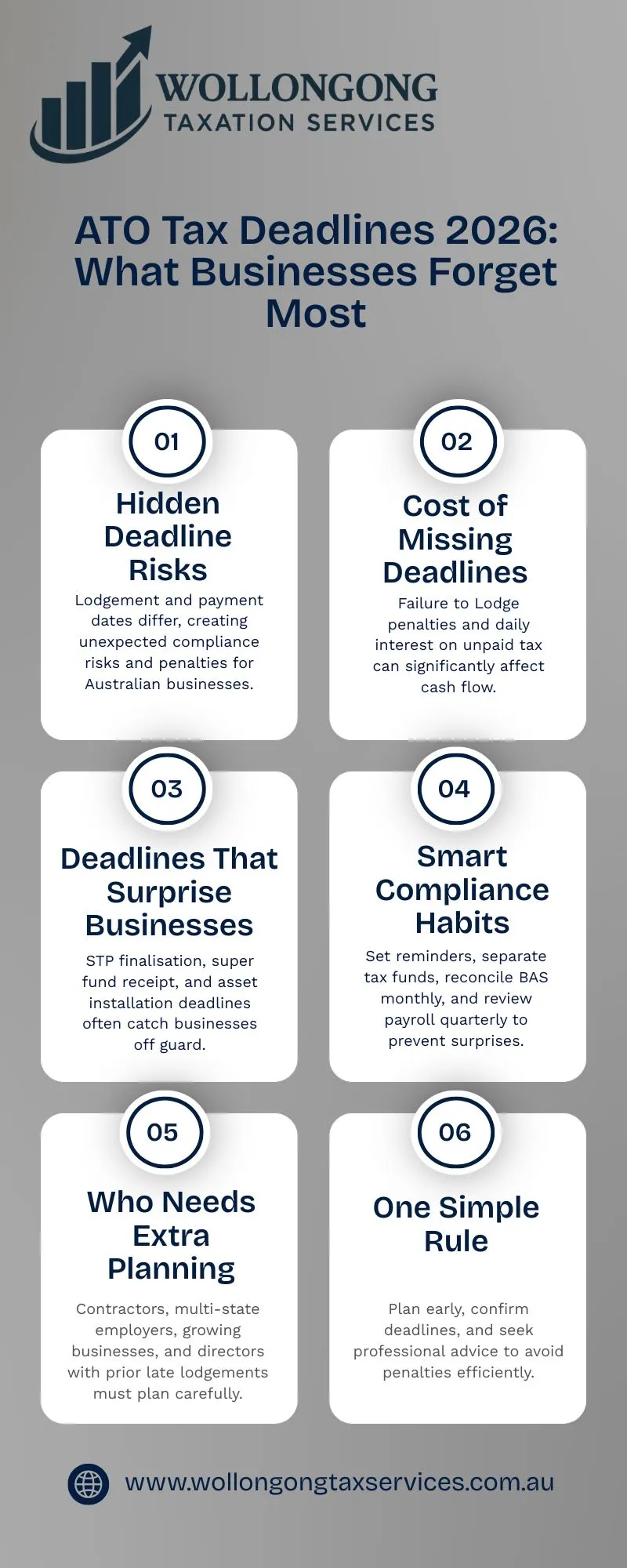
ATO Tax Deadlines 2026: What Businesses Forget Most
How to Stay Compliant in 2026
Create a Tax Compliance Calendar
Map all ATO tax deadlines 2026, including Company tax return deadlines, BAS lodgement due dates, PAYG instalment deadlines 2026, Payroll tax deadlines, and Superannuation deadlines 2026.
Use Accounting Software
ATO-compliant digital solutions can automate reminders and reduce manual errors.
Work with a Registered Tax or BAS Agent
The Tax Practitioners Board regulates registered agents. Engaging a registered professional ensures access to lodgement concessions and compliance oversight.
Set Payment Reminders and Cash Flow Buffers
Professional bodies recommend maintaining cash reserves to manage quarterly spikes in liabilities. Industry guidance from the Australian Small Business and Family Enterprise Ombudsman supports proactive cash flow planning.
2026 Tax Deadline Calendar Summary
| Obligation | Due Date |
| EOFY cut-off | 30 June 2026 |
| STP finalisation | 14 July 2026 |
| Income tax (self-lodged) | 31 October 2026 |
| Payroll tax reconciliation | July 2026 |
| Company returns (via agent) | Feb–May 2027, depending on eligibility |
Always confirm dates via the official ATO key dates page and the relevant state revenue authority.
Conclusion
Staying compliant with ATO tax deadlines in 2026 is not optional for Australian businesses. Income tax, BAS, PAYG, payroll tax, and superannuation all have strict due dates, and missing any of them can quickly lead to penalties, interest, and unnecessary cash flow pressure. Planning, understanding your reporting frequency, and acting early are the most effective ways to stay in control and avoid last-minute risks.
If you want confidence that every deadline is met correctly and on time, Wollongong Tax Services can help. Their experienced team supports individuals and businesses with BAS, tax returns, PAYG, and superannuation compliance. Contact us today to schedule a consultation and simplify how you manage your 2026 tax obligations with confidence.
FAQs
What is the BAS lodgement deadline for Q4 2026?
Quarter 4 (Apr–Jun 2026) BAS is generally due 28 July 2026, per ATO BAS guidance. This deadline applies unless the business uses electronic lodgement, which may allow additional time.
When are superannuation payments due in 2026?
The ATO confirms quarterly due dates of 28 October, 28 January, 28 April and 28 July.
What happens if I miss a company tax return deadline?
Failure to lodge penalties may apply, and interest accrues on unpaid tax. Directors may face further action if PAYG or super remains unpaid.
Can I get an extension from the ATO?
Yes. The ATO may grant deferrals or payment plans where justified. The ATO may also grant extensions under hardship or disaster provisions, provided requests are submitted before the due date.
What are PAYG instalment due dates in 2026?
The PAYG instalment deadlines 2026 generally align with quarterly BAS dates: 28 October, 28 February, 28 April and 28 July.