For trustees and company directors in Australia, keeping track of tax deadlines is a key part of staying compliant with the Australian tax system. Missing important lodgement dates can lead to penalties, interest charges, or regulatory scrutiny. This guide explains the ATO SMSF tax return deadline, along with key timelines for SMSF audits, tax payments, and the company tax return due date for 2026.
What Is an SMSF Tax Return and Who Must Lodge?
A Self-Managed Super Fund (SMSF) tax return is an annual report that trustees must lodge with the Australian Taxation Office. It combines several reporting obligations in a single form, including the fund’s income tax return, regulatory information, and member contribution details.
Every SMSF must lodge an annual return, even if the fund had no income or limited activity during the financial year. According to the Australian Taxation Office, SMSFs are required to report their financial position, investments, and compliance status each year through the SMSF annual return.
Trustees can either:
- Lodge the return themselves through the ATO portal
- Engage a registered tax agent who lodges under the ATO lodgement program
Understanding the correct SMSF tax return due date is essential because the return also confirms that the fund has met its regulatory obligations, including completing the mandatory SMSF tax return and audit process before lodgement. The return applies to all registered SMSFs regulated by the ATO under Australia’s superannuation law framework.
Why SMSF Tax Return Deadlines Matter
Meeting the ATO SMSF tax return deadline is critical because SMSFs operate under strict compliance rules governed by Australian superannuation legislation. Lodging the return on time confirms that the fund has met regulatory requirements and accurately reported its financial activity.
SMSF Association explains that timely reporting ensures trustees demonstrate proper governance and transparency of retirement savings.
Late lodgement can lead to:
- Administrative penalties issued to individual trustees
- Loss of certain regulatory concessions
- Increased scrutiny from the ATO
In addition, missing the SMSF tax return due date may delay tax assessments and affect member reporting. The ATO may also impose a General Interest Charge (GIC) on unpaid tax amounts if payment deadlines are missed. Many trustees also operate companies or hold company investments through their SMSF. As a result, the company tax return due date may overlap with SMSF reporting obligations, creating additional compliance pressure for directors managing both responsibilities.
SMSF Tax Return Due Date 2026
Understanding the key SMSF tax return due date helps trustees avoid penalties and maintain compliance with ATO regulations. It also helps to stay across the broader ATO tax changes for 2026 that may affect how funds are assessed.
Standard Lodgement Deadline (Self-Lodging Trustees)
For most SMSFs lodging their own return without a tax agent, the ATO SMSF tax return deadline is 31 October 2026 for the 2025–26 financial year.
This date applies to funds that are already registered and have previously lodged returns on time.
The Australian Taxation Office confirms that trustees who self-lodge must submit their SMSF annual return by 31 October each year unless the fund is newly registered.
Deadlines for Newly Registered SMSFs
Newly established SMSFs may have different lodgement requirements.
For example:
- A new SMSF must lodge its first return after the end of the financial year in which it was created.
- The lodgement date may vary depending on the registration date and whether a tax agent is involved.
- The ATO provides guidance for first-year SMSF reporting through its superannuation compliance framework.
Extended Deadlines via Registered Tax Agent
Many trustees work with accountants or tax professionals who lodge returns through the ATO’s tax agent lodgement program.
Under this system:
- SMSF returns may receive extended lodgement dates
- Deadlines can extend into May of the following year
The ATO explains that registered tax agents receive staggered lodgement schedules depending on the client’s compliance history and risk profile. Engaging a tax agent early is important because extensions only apply if the fund is added to the agent’s lodgement list before the original due date.
Deferrals, Extensions, and Special Circumstances
In limited circumstances, trustees may apply for lodgement deferrals.
Common reasons include:
- Natural disasters
- Serious illness or unexpected business disruption
- System issues affecting lodgement
The ATO reviews deferral requests individually and determines whether an extension is appropriate.
SMSF Audit Requirements and Timeline
Before lodging the annual return, every SMSF must complete a mandatory independent audit.
When the Audit Must Be Completed
The SMSF tax return and audit process follows a strict order. The audit must be completed before the SMSF annual return is lodged with the ATO. The auditor reviews the fund’s financial statements and compliance with superannuation regulations.
According to ATO guidance, trustees must provide the audit report details when submitting the SMSF return. Trustees who want to understand what triggers an audit more broadly should also review our guide to tax audits in 2026.
Who Can Legally Perform an SMSF Audit
SMSF audits can only be performed by ASIC-registered SMSF auditors.
These professionals must:
- Be registered with the Australian Securities and Investments Commission (ASIC)
- Follow auditing standards established under Australian auditing regulations
The SMSF Association also publishes professional guidance on auditor independence and compliance practices.
Documents Required Before the Audit
Trustees should prepare several records before the audit begins. Knowing a tax return in Australia is a useful starting point, and SMSF-specific records include:
- Financial statements and income reports
- Investment transaction records
- Bank account statements
- Trustee declarations
- Member contribution records
Providing complete documentation helps auditors verify compliance and reduces delays before the SMSF tax return due date. Maintaining clean records throughout the year through proper bookkeeping makes this process significantly easier.
Consequences of Missing the Audit Deadline
If the audit is not completed on time:
- The SMSF annual return cannot be lodged
- The fund may miss the ATO SMSF tax return deadline
- The ATO may impose administrative penalties
Repeated compliance failures may also trigger additional regulatory review.
ATO Payment Due Dates for SMSF Tax
After lodging the SMSF annual return, trustees must ensure any tax liabilities are paid by the required deadline.
When SMSF Tax Payments Are Due
In most cases, ATO payment due dates align with the SMSF lodgement date.
This means:
- If a trustee self-lodges, payment is generally due shortly after 31 October
- If lodged through a tax agent, payment dates follow the extended lodgement schedule
The Australian Taxation Office confirms that SMSF tax payments must be made according to the notice of assessment issued after lodgement.
Accepted Payment Methods
The ATO allows several payment options:
- BPAY using the SMSF payment reference number
- Online payments through the ATO online services
- Payment through registered tax agent portals
- Direct transfer via electronic banking
These systems are designed to simplify compliance with ATO payment due dates.
Consequences of Late Payment
If SMSF tax payments are late, the ATO may apply:
- General Interest Charge (GIC)
- Penalties on outstanding tax liabilities
- ATO guidance notes that interest charges accrue daily until the debt is cleared.
Company Tax Return Due Date in Australia 2026
Many trustees also operate companies or hold company investments within their SMSF portfolio. As a result, the company tax return due date is another important compliance milestone.
Standard Company Tax Return Deadline
For most companies that lodge through a tax agent and have a standard reporting cycle, the company tax return due date is typically 28 February of the following year.
The Australian Taxation Office confirms that companies must lodge their annual tax return reporting income, deductions, and tax liabilities for the financial year.
Tax Agent Lodgement Program Dates
Like SMSFs, companies may receive extended lodgement dates under the ATO tax agent lodgement program.
These extensions depend on:
- Lodgement history
- Compliance record
- Whether the company is newly registered
First-Year Company Lodgement Rules
Companies lodging their first tax return may receive different deadlines depending on when the entity was established and whether a tax agent manages the lodgement.
ATO guidance explains that first-year companies should confirm their lodgement due date through the ATO portal or their registered agent.
How Company Deadlines Interact with SMSF
Directors who manage both corporate entities and SMSFs must monitor multiple compliance obligations.
For example:
- SMSFs may hold company shares or private company investments
- Trustees who are also directors must track both the SMSF tax return due date and the company tax return due date
This overlap makes accurate record-keeping and early planning essential. Trustees who also employ staff should also be aware of payday super obligations for 2026, which add a further layer of compliance to manage alongside SMSF and company reporting.
2026 ATO Compliance Calendar
Below is a simplified compliance overview combining major SMSF tax return due dates, audit requirements, and ATO payment due dates.
| Milestone | Standard Date | With Tax Agent |
| SMSF Audit Completion | Before lodgement | Before lodgement |
| SMSF Tax Return Lodgment | 31 Oct 2026 | May extend to May 2027 |
| SMSF Tax Payment | By lodgment date | Aligned with lodgment |
| Company Tax Return | 28 Feb 2027 (most) | Per agent program |
Penalties for Missing ATO SMSF and Company Tax Deadlines
Failure to meet the ATO SMSF tax return deadline or the company tax return due date may lead to penalties and compliance action. Trustees can also review our BAS lodgement guide for additional context on how the ATO handles late lodgements across different return types.
SMSF Administrative Penalties
Under superannuation law, trustees can receive administrative penalties measured in penalty units. According to ATO guidance, individual trustees may be personally responsible for paying these penalties.
Company Late Lodgement Penalties
Companies that miss the company tax return due date may receive late lodgement penalties that increase depending on how long the return remains outstanding.
General Interest Charges on Late Payments
Late tax payments can trigger the General Interest Charge (GIC), which compounds daily until the outstanding amount is paid.
How the ATO Escalates Non-Compliance
If repeated non-compliance occurs, the ATO may:
- Conduct compliance reviews
- Issue formal directions to trustees
- Apply stronger enforcement measures
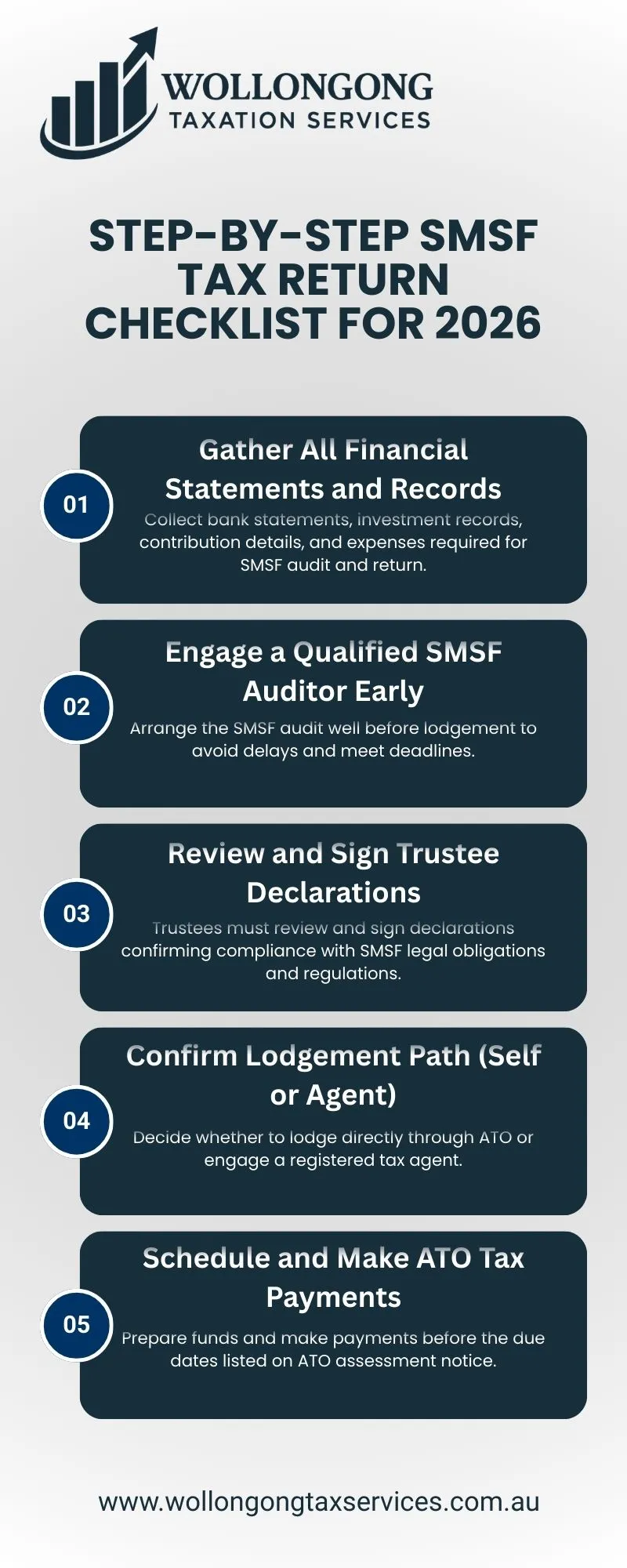
Step-by-Step SMSF Tax Return Checklist for 2026
Tips to Stay Compliant With ATO Deadlines
Maintaining compliance with the ATO SMSF tax return deadline requires organisation and planning. Our EOFY 2026 tax return tips also cover practical strategies to lodge early and avoid common errors that apply equally to SMSF trustees.
Use a Compliance Calendar
A compliance calendar helps trustees track:
- SMSF tax return due date
- ATO payment due dates
- company tax return due date
Work With an SMSF Specialist Accountant or Tax Agent
Professional advisers can help manage lodgement obligations and ensure compliance with ATO regulations.
Monitor ATO Portal Notifications and Updates
Trustees should regularly review ATO online services to check notices, updates, and payment reminders.
Plan Cash Flow for Tax Payments Well in Advance
Setting aside funds throughout the year helps ensure SMSF tax liabilities can be paid before the relevant ATO payment due dates.
Conclusion
Understanding the ATO SMSF tax return deadline and related compliance requirements is essential for trustees and company directors in Australia. Key dates such as the SMSF tax return due date, completion of the SMSF tax return and audit, relevant ATO payment due dates, and the company tax return due date should all be tracked carefully throughout the financial year.
Preparing early, keeping accurate financial records, and scheduling the SMSF audit well before the lodgement deadline can help avoid penalties and delays. Many trustees also work with registered tax agents to manage deadlines under the ATO lodgement program.
Stay on top of your SMSF and company tax obligations. Contact Wollongong Tax Services today to ensure timely lodgement, accurate records, and expert guidance for 2026.
FAQs
What is the SMSF tax return due date for 2026?
The ATO SMSF tax return deadline for self-lodging trustees is 31 October 2026. Using a registered tax agent may extend the lodgement date to May 2027.
Does an SMSF audit need to be completed before lodging the return?
Yes. The SMSF tax return and audit must be completed before submission. Auditors verify financial statements and compliance, and lodgement cannot occur without an approved audit report.
When are SMSF tax payments due?
ATO payment due dates for SMSFs are generally aligned with lodgement. Payments must be made by the date shown on the notice of assessment to avoid interest and penalties.
What is the company tax return due date for 2026?
For most companies using a tax agent, the company tax return due date is 28 February 2027. First-year companies or self-lodging may have different dates.
What happens if SMSF or company tax returns are lodged late?
Late lodgement may incur administrative penalties, general interest charges, and ATO compliance action. Repeated delays can trigger reviews or enforcement measures.
Can the ATO grant extensions for SMSF tax returns?
Yes. Deferrals are possible for special circumstances like serious illness or natural disasters, but approval is assessed individually and extensions must be requested before the original due date.