The ATO tax changes 2026 are set to reshape how individuals and small businesses manage tax. From new income tax brackets to superannuation updates and compliance rules, these Australian tax changes 2026 will affect take-home pay, BAS lodgements, and reporting obligations across the Illawarra region.
What Are the ATO Tax Changes for 2026?
The Australian tax changes 2026 refer to a series of updates announced through the Federal Budget and ongoing tax reform measures. These include:
- Revised individual income tax rates under the Stage 3 tax cuts
- Updates to Australian tax brackets 2026
- Superannuation guarantee increases
- Small business tax changes 2026
- PAYG withholding changes 2026
- Expanded digital reporting and ATO compliance changes 2026
In simple terms, think of the system like a rulebook that gets a yearly refresh. The ATO updates 2026 adjust how much tax you pay, how businesses report income, and how superannuation is managed.
You can review official updates via the Australian Taxation Office website
Budget announcements are available from the Australian Government Treasury
Why the ATO Is Introducing Tax Changes in 2026
Tax reform in Australia 2026 is driven by three main goals:
- Address bracket creep caused by inflation
- Simplify income tax structures
- Strengthen digital tax compliance
Inflation pushes wages up over time. Without changes, taxpayers can slide into higher brackets without real increases in buying power. The Stage 3 tax cuts of 2026 aim to reduce this effect.
At the same time, the ATO’s new rules for 2026 focus on transparency. With improved data matching and real-time reporting, the ATO reporting requirements 2026 are becoming more automated.
This is less about increasing taxes and more about modernising the system. Think of it as upgrading from paper maps to GPS clearer guidance, but with less room for error.
New Individual Income Tax Rates for 2026
The income tax changes 2026 Australia centre on revised brackets and adjustments under the Stage 3 tax cuts.
Updated Tax Brackets
From 1 July 2026, the simplified Australian tax rates 2026 are expected to maintain the three-bracket structure introduced under Stage 3 reforms.
These changes flatten middle brackets, meaning moderate earners keep more of each extra dollar earned.
Changes to the Tax-Free Threshold
The tax-free threshold remains a key focus. It determines how much income you earn before paying tax. For a deeper breakdown on how to maximise take-home pay, see:
Even small threshold adjustments can shift annual refunds or tax payable.
Impact on Low- and Middle-Income Earners
Lower marginal rates may improve take-home pay slightly. However, the Low and Middle Income Tax Offset has already phased out, meaning refunds may not be as large as in prior years.
Impact on High-Income Earners
High earners will still benefit from bracket simplification. However, the Medicare levy changes for 2026 thresholds may influence total liability.
Changes to Superannuation Rules
Super reforms are a major part of the federal budget tax changes for 2026.
Contribution Caps Updates
Concessional contribution caps are indexed periodically. Exceeding caps can trigger additional tax, so careful tracking matters.
Tax on Super Balances Over Thresholds
Balances exceeding $3 million remain subject to additional tax measures. This primarily affects high-balance members and SMSFs.
Changes to Employer Super Guarantee Rates
The superannuation guarantee rate reaches 12% from 1 July 2025 and continues at that rate in 2026. Employers must adjust payroll systems accordingly.
These changes form part of the broader STP reporting changes 2026 and payroll tax changes 2026 compliance updates.
For practical employer guidance, see: Payday Super 2026: What Australian Employers Need to Know
Small Business Tax Changes in 2026
The small business tax changes of 2026 affect sole traders and companies alike.
Company Tax Rate Adjustments
The base rate entity company tax rate remains 25% for eligible small companies. Always confirm deadlines and penalties when lodging your company tax return.
Instant Asset Write-Off Updates
The Instant Asset Write Off 2026 threshold depends on federal announcements. Businesses should confirm eligibility before purchasing equipment.
Changes to Business Deductions
Expect tighter scrutiny on motor vehicle, home office, and travel claims as part of the ATO compliance changes 2026.
Digital Reporting and Compliance Requirements
GST changes 2026, Australia and BAS changes 2026 increasingly rely on digital reporting. STP Phase 2 continues expanding payroll transparency.
Think of it as driving with headlights on, so the ATO can see more clearly in real time.
Capital Gains Tax (CGT) Updates
Capital Gains Tax updates under the new tax laws in Australia 2026 mainly relate to reporting accuracy.
Property Investment Impacts
Investment property sales remain subject to CGT, with the 50% discount available for assets held over 12 months.
Changes for Shares and Managed Funds
Pre-filled ATO myGov tax changes data continues to improve accuracy for share transactions.
Main Residence Exemption Rules
The main residence exemption remains available, subject to absence rules and foreign resident restrictions.
PAYG and Withholding Changes
Updated PAYG Withholding Tables
PAYG withholding changes 2026 align with updated income tax rates 2026. Employers must apply revised tables from 1 July 2026.
Employer Reporting Obligations
Single Touch Payroll reporting remains mandatory. Errors in withholding can trigger ATO penalties in 2026 and interest charges.
Changes to Deductions and Offsets
Work-From-Home Deduction Rules
The work from home deduction 2026 continues using the fixed rate method unless updated. Record-keeping remains critical.
Tax Offsets and Rebates
Offsets are narrower than during the COVID-era measures. Always verify eligibility.
Education and Training Deductions
Self-education expenses remain deductible when directly related to income.
Check deduction eligibility here.
How the 2026 Tax Changes Affect Different Taxpayers
Employees
Employees may see modest take-home pay changes due to updated tax brackets and PAYG withholding changes in 2026.
Sole Traders
Sole trader tax changes 2026 focus on digital compliance and BAS accuracy.
Property Investors
CGT reporting scrutiny increases, particularly for short-term property flips.
Retirees
Superannuation balance thresholds and pension phase limits remain important planning factors.
Benefits of the 2026 ATO Tax Changes
The tax reform Australia 2026 measures aim to:
Reduce bracket creep
Improve digital efficiency
Simplify income tax structures
Increase retirement savings
Over time, this should create a clearer and more predictable tax environment.
Risks and Compliance Challenges
With stronger ATO audit changes in 2026 and enhanced data matching, mistakes are easier to detect. Late lodgements can result in penalties. Learn more about audit risks here: Tax Audit 2026 Guide: Avoid ATO Penalties & Risks
Accurate records are your best defence.
How to Prepare for the ATO Tax Changes 2026
Preparation prevents stress at tax time.
Review Your Tax Position
Assess income, deductions, and expected bracket changes before 30 June.
Adjust PAYG and Withholding
Employers should update payroll systems ahead of new rates.
Update Accounting Software
Ensure bookkeeping systems reflect the GST changes 2026, Australia, and STP reporting changes 2026.
Seek Professional Advice
Proactive planning can reduce risk. Review practical EOFY 2026 tips.
Think of tax planning like servicing a car before a long trip; small checks prevent bigger breakdowns.
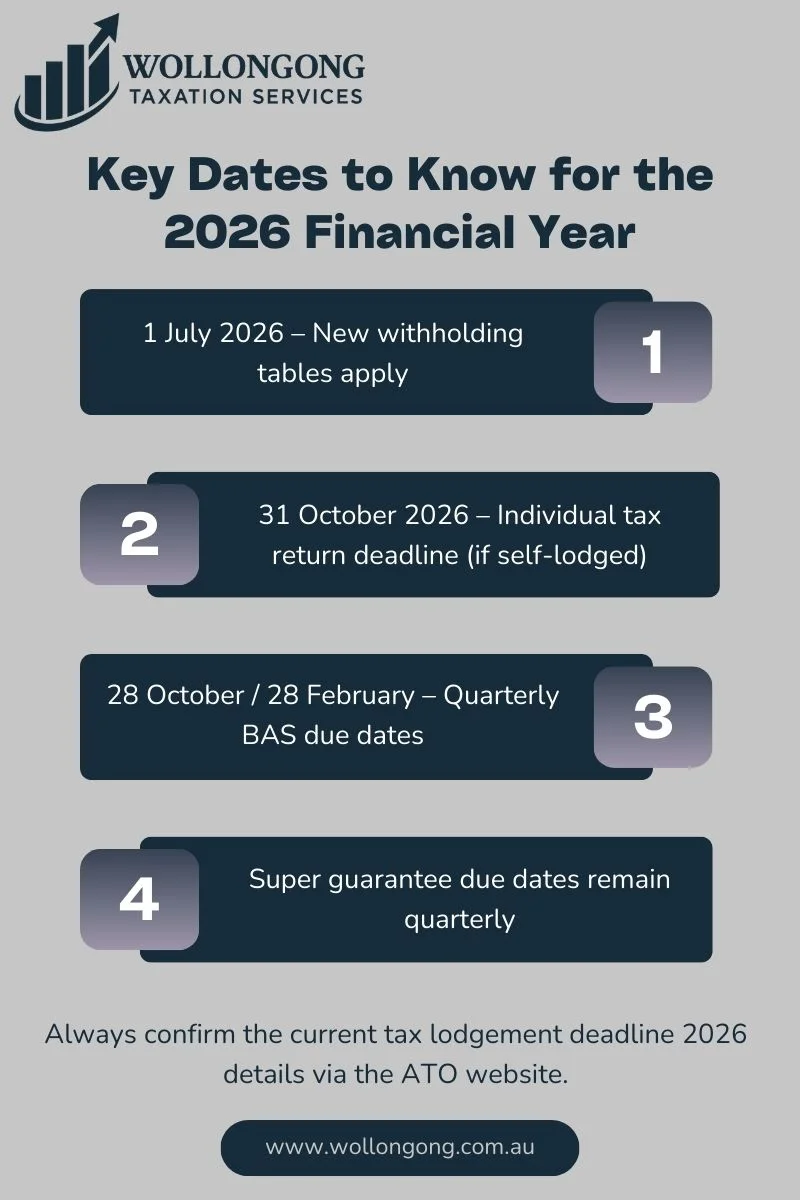
Key Dates to Know for the 2026 Financial Year
Need Help With the ATO Tax Changes 2026? Get Wollongong Tax Services on Your Side
Reading about the ATO tax changes 2026 can feel overwhelming, especially if you’re trying to apply them to your own tax return, bookkeeping, BAS lodgement, or payroll. That’s where Wollongong Tax Services steps in to help everyday taxpayers and small business owners across Wollongong and the Illawarra region.
Tax rules may look straightforward in theory, but once you start crunching numbers, calculating deductions, or updating payroll systems for PAYG withholding changes 2026, things get tricky. One missed step can cost you time, money, or even attract penalties under the new ATO compliance changes 2026
Contact Wollongong Tax Services today to get personalised advice before 30 June 2026 and make sure your tax position is compliant and optimised.
FAQs
When do the ATO tax changes 2026 take effect?
Most income tax changes in 2026 in Australia begin from 1 July 2026, unless otherwise announced in the Federal Budget.
Will my take-home pay increase in 2026?
It depends on your income level and withholding adjustments. Middle-income earners may see modest relief.
Are small businesses getting new tax concessions?
The instant asset write-off 2026 threshold depends on the Federal Budget settings each year.
Do I need to update my PAYG withholding?
Yes. Employers must apply updated PAYG withholding tables from the effective date.
How do the changes affect property investors?
Primarily through CGT reporting and data matching enhancements.
Are superannuation contribution caps increasing?
Caps are indexed periodically. Confirm via the ATO before contributing.
What records do I need to keep under the new rules?
Keep income statements, receipts, logbooks, super records, and BAS documentation for at least five years.
Should I see a tax accountant before June 30, 2026?
Yes. Reviewing your position before EOFY can reduce errors and improve tax outcomes under the ATO tax return 2026 rules.