
Australian Accounting Standards form the foundation of financial reporting and corporate transparency in Australia. These standards define how businesses record, present, and disclose financial information so that investors, regulators, and stakeholders can make informed decisions. They are developed and maintained by the Australian Accounting Standards Board (AASB), the independent body responsible for issuing national reporting standards.
Australia’s reporting framework is closely aligned with global accounting rules through the adoption of IFRS in Australia, ensuring consistency with international financial markets. Businesses ranging from listed corporations and large proprietary companies to not-for-profit organisations and government entities must comply with these requirements.
What Are Australian Accounting Standards?
Australian Accounting Standards are formal financial reporting rules that govern how organisations prepare and present their financial statements. The primary goal of these standards is to ensure consistency, transparency, and comparability across financial reports.
In practice, these standards define:
- How revenue and expenses should be recognised
- How assets and liabilities must be measured
- What disclosures must appear in financial statements
- How companies present financial reports to stakeholders
According to the Australian Accounting Standards Board, these rules are designed to produce financial information that is “useful to investors, lenders and other creditors in making decisions about providing resources to the entity”.
These reporting principles form the backbone of Australian financial reporting standards, ensuring that financial statements across industries follow consistent practices. Without these standards, companies could use different accounting approaches, making financial comparisons unreliable.
Who Creates These Standards?
The AASB standards framework is developed by the Australian Accounting Standards Board, an independent agency under the Australian Government Treasury portfolio.
The AASB’s mandate includes:
- Developing and issuing accounting standards for Australia
- Aligning national rules with global accounting frameworks
- Supporting public sector and not-for-profit reporting standards
The organisation operates under authority from the Australian Government, with oversight provided through the Treasury department. The Australian Treasury outlines the board’s legislative role and governance responsibilities in financial reporting regulation.
Through this structure, Australia maintains a unified national accounting framework integrated with international reporting practices.
What Is the Australian Accounting Standards Board (AASB)?
The Australian Accounting Standards Board (AASB) is the national authority responsible for developing and maintaining accounting standards used across Australia’s corporate, public, and not-for-profit sectors.
Responsibilities of the AASB
The board’s primary responsibilities include:
- Issuing AASB standards for financial reporting
- Aligning Australian rules with international standards
- Developing reporting standards for the public sector
- Maintaining the conceptual framework that supports financial reporting
These responsibilities ensure that the country’s accounting framework remains current and consistent with international developments.
How the AASB Develops New Standards
The process of developing new standards typically includes:
- Research and consultation
- Public exposure drafts
- Feedback from accountants, businesses, and regulators
- Final approval and publication
According to the official AASB documentation, public consultation is a critical part of the process to ensure that standards are practical and widely accepted.
AASB’s Relationship With Global Regulators
The AASB works closely with international bodies such as the IFRS Foundation to maintain compatibility between Australian rules and global financial reporting standards. This alignment allows companies operating internationally to maintain comparable financial statements.
Structure of the Australian Accounting Framework
Australia’s accounting environment operates within a structured regulatory framework that integrates accounting standards, corporate law, and financial market oversight.
Key Components of the Framework
The national framework supporting Australian financial reporting standards includes several core components:
- AASB Standards: Detailed accounting rules covering revenue recognition, leases, financial instruments, and disclosures
- Conceptual Framework: Principles guiding financial reporting, objectives, and measurement approaches
- Reporting Entities Concept: Defines which organisations must produce general-purpose financial statements
- Australian Financial Reporting Standards (AFRS): The combined framework integrating local standards with IFRS in Australia
These components form a structured system designed to ensure accurate financial reporting across both private and public sectors.
Role of Regulatory Bodies
While the AASB issues accounting standards, other regulatory agencies enforce compliance. The Australian Securities and Investments Commission (ASIC) oversees corporate financial reporting and ensures companies comply with reporting obligations under the Corporations Act. ASIC regularly reviews financial statements and can take enforcement action where reporting standards are not met.
For listed companies, the Australian Securities Exchange (ASX) sets additional corporate governance and disclosure requirements. ASX listing rules reinforce financial transparency and timely reporting to investors.
Together, these regulators ensure that accounting systems Australia relies on to produce accurate and compliant financial statements. Understanding tax laws in Australia is equally important, as the legal obligations underpinning financial reporting flow directly from the broader tax and corporate law environment.
Overview of Australian Financial Reporting Standards (AFRS)
Australian financial reporting standards (AFRS) represent the broader reporting framework that combines AASB standards with international accounting rules adopted by Australia.
Purpose of Financial Reporting Standards
The goal of AFRS is to ensure that financial statements provide relevant and reliable information to investors, regulators, creditors, and other stakeholders. Financial reports prepared under these standards typically include:
- Statement of financial position
- Statement of profit or loss
- Cash flow statement
- Notes and disclosures
These documents provide a complete picture of an organisation’s financial performance and position.
Entities Required to Follow AFRS
Entities typically required to follow AFRS include:
- Public companies listed on the ASX
- Large proprietary companies
- Government agencies
- Not-for-profit organisations with reporting obligations
Many smaller entities may qualify for simplified reporting frameworks but still follow core principles within Australian Accounting Standards.
Public vs Private Sector Reporting Requirements
Although both sectors apply AASB standards, reporting requirements may vary slightly.
For example:
- Public sector entities often require additional disclosures related to government funding and accountability.
- Private companies focus primarily on investor and creditor transparency.
Despite these differences, the overall goal remains consistent: ensuring financial reports produced within accounting systems in Australia are transparent, consistent, and comparable across organisations.
Understanding IFRS in Australia
What Is IFRS?
The International Financial Reporting Standards (IFRS) are globally recognised accounting rules designed to standardise financial reporting across countries. These standards are issued by the International Accounting Standards Board under the IFRS Foundation.
The IFRS Foundation explains that IFRS aims to create “a common global accounting language for business affairs so company accounts are understandable and comparable across international boundaries”.
Why Australia Adopted IFRS
Australia formally adopted IFRS-aligned standards in 2005 to improve financial reporting consistency with global markets.
According to CPA Australia, the adoption was intended to:
- Improve transparency for international investors
- Reduce reporting complexity for multinational companies
- Enhance the comparability of financial statements worldwide
This decision significantly reshaped Australian GAAP and integrated global standards into national regulations.
How IFRS Is Integrated Into AASB Standards
Most AASB standards directly incorporate IFRS rules with minor Australian-specific additions. This approach allows companies to produce financial statements that comply with both local regulations and international reporting expectations.
Key Differences Between IFRS and Local Australian Requirements
Although IFRS in Australia largely mirrors international rules, there are several local modifications.
| Area | IFRS | Australian Requirements |
| Public sector reporting | Limited coverage | Additional disclosures for government entities |
| Not-for-profit reporting | Minimal focus | Expanded standards for charities and NGOs |
| Regulatory oversight | Global standard-setting | Enforced through ASIC and the Corporations Act |
These modifications ensure the standards remain suitable for Australia’s legal and regulatory environment.
Key Differences Between Australian GAAP vs IFRS
What Is Australian GAAP?
Australian GAAP (Generally Accepted Accounting Principles) refers to the historical framework of accounting practices used in Australia before IFRS adoption.
These principles were originally developed through local accounting standards and professional guidance issued by accounting bodies and regulators.
How Australian GAAP Evolved After IFRS Adoption
After Australia adopted IFRS in 2005, the structure of Australian GAAP changed significantly. Many traditional local accounting rules were replaced or rewritten to align with international standards.
Chartered Accountants Australia explains that modern Australian GAAP now largely consists of IFRS-based standards issued by the AASB, with additional requirements for public sector and not-for-profit organisations.
Relationship Between GAAP, IFRS, and AASB Today
Today’s framework works as follows:
- IFRS provides global accounting principles
- AASB standards adapt these rules for Australian law and industry
- Australian GAAP effectively represents the complete national framework, incorporating both
This structure allows Australian businesses to maintain compliance locally while still producing internationally comparable financial statements.
Key Australian Accounting Standards Businesses Must Know
Several Australian Accounting Standards play a central role in modern financial reporting.
AASB 15: Revenue from Contracts with Customers
AASB 15 defines how businesses recognise revenue from contracts. The standard introduces a five-step model for identifying revenue obligations and recognising income as performance obligations are satisfied. For many industries, such as construction, technology, and services, this standard significantly changed revenue recognition practices.
AASB 16: Leases
AASB 16 requires most leases to appear on company balance sheets. Previously, many operating leases remained off-balance-sheet. This change improved transparency by requiring organisations to recognise:
- Lease assets
- Lease liabilities
Companies with significant property or equipment leases experienced notable financial reporting changes after itstheir implementation.
AASB 9: Financial Instruments
AASB 9 governs how financial assets and liabilities are classified, measured, and impaired. It introduced new credit loss models requiring companies to estimate expected credit losses rather than waiting for actual losses to occur.
AASB 136: Impairment of Assets
This standard ensures that assets are not carried at amounts higher than their recoverable value. Businesses must regularly assess whether assets such as goodwill, equipment, or investments have declined in value.
AASB 101: Presentation of Financial Statements
AASB 101 establishes the structure and presentation of financial statements. It defines requirements for:
- Balance sheet format
- Income statement presentation
- Disclosure of accounting policies
The full database of current AASB standards is available through the official AASB standards portal.
Benefits of Following Australian Accounting Standards
Compliance and Legal Requirements
Adhering to Australian Accounting Standards is a legal requirement for many organisations under the Corporations Act.
Failure to comply can result in:
- Regulatory investigations
- Financial penalties
- Reputational damage
ASIC regularly reviews company financial statements to ensure compliance with Australian financial reporting standards. For businesses that are also subject to periodic scrutiny from the ATO, understanding the tax audit process can help organisations prepare for the type of detailed financial review that robust accounting standards are designed to support.
Benefits for Investors and Stakeholders
Beyond legal obligations, these standards provide several practical advantages:
- Improved financial transparency
- Greater investor confidence
- Consistent reporting across industries
- Reduced financial reporting risk
Standardised reporting allows investors to compare financial performance across companies, industries, and even countries due to alignment with IFRS in Australia.
Common Financial Reporting Challenges for Australian Businesses
Despite the benefits of standardised reporting, businesses often face challenges implementing AASB standards.
Keeping Up With Changing Standards
Accounting regulations evolve frequently. Updates to Australian financial reporting standards may require companies to adjust policies, update systems, and retrain staff. Staying current with ATO tax changes in 2026 is part of this ongoing compliance responsibility for businesses navigating a shifting regulatory landscape.
Complex Revenue Recognition Rules
Standards like AASB 15 introduce detailed revenue recognition requirements that can be difficult to implement without strong internal controls.
Lease Accounting Compliance
AASB 16 requires companies to record lease liabilities and assets, which may require significant changes to financial reporting processes.
Consolidation and Reporting Complexity
Large organisations with multiple subsidiaries often face complex consolidation requirements under Australian Accounting Standards. Large organisations with multiple subsidiaries often face complex consolidation requirements under Australian Accounting Standards. For companies operating with corporate structures, understanding company tax return obligations, including deadlines and potential penalties, sits alongside AASB compliance as a core reporting responsibility.
Training and Compliance Costs
Professional accounting organisations highlight that maintaining compliance often requires ongoing training and investment in technology systems.
How to Ensure Compliance With AASB Standards
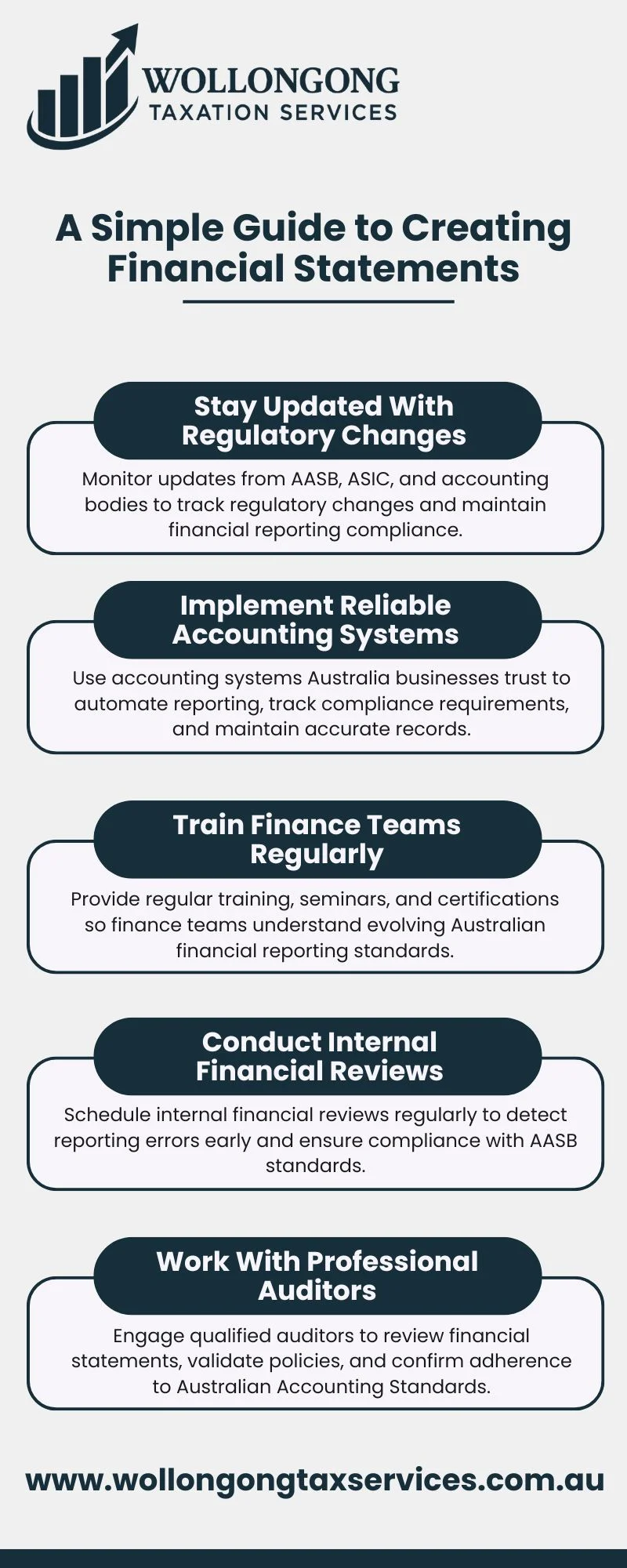
Conclusion
Australian Accounting Standards play a vital role in ensuring financial transparency, accountability, and comparability across the Australian economy. Developed by the AASB and supported by regulators such as ASIC, these standards form the foundation of modern financial reporting. By aligning closely with IFRS in Australia, the national framework ensures that financial statements prepared under AASB standards remain consistent with global reporting practices.
For businesses, accountants, and finance professionals, understanding Australian financial reporting standards is essential for regulatory compliance and stakeholder trust. As financial reporting continues to evolve with digital transformation and sustainability standards, staying informed through official guidance from the AASB, ASIC, and professional accounting bodies as well as keeping on top of ATO tax deadlines, remains critical.
FAQs
Who regulates Australian Accounting Standards?
The Australian Accounting Standards Board develops and issues Australian Accounting Standards. Compliance for corporations is enforced by the Australian Securities and Investments Commission, which reviews financial reports under the Corporations Act.
Are Australian Accounting Standards the same as IFRS?
IFRS in Australia forms the basis of most AASB standards, meaning the frameworks are largely aligned. However, Australia includes additional requirements for public sector and not-for-profit organisations.
What companies must follow Australian Accounting Standards?
Public companies, large proprietary companies, many not-for-profit organisations, and government entities must follow Australian Accounting Standards when preparing financial statements.
Why are accounting systems important for AASB compliance?
Modern accounting systems Australia businesses use help automate financial reporting, maintain audit trails, and ensure reports meet Australian financial reporting standards required by regulators.