
A BAS return (Business Activity Statement) is a form Australian businesses submit to the ATO to report taxes such as GST, PAYG withholding, and PAYG instalments. Businesses registered for GST must complete BAS lodgement monthly, quarterly, or annually depending on their annual turnover and reporting obligations.
For many Australian small business owners, sole traders, and startups, understanding BAS returns can feel complex at first. However, once you understand the structure, due dates, and calculation methods, BAS reporting becomes a manageable routine task.
What is BAS?
A Business Activity Statement (BAS) is the official tax reporting document used by Australian businesses to report and pay certain taxes to the Australian Taxation Office (ATO).
According to the ATO, businesses use the BAS form to report:
- Goods and Services Tax (GST)
- Pay As You Go (PAYG) withholding
- PAYG instalments
- Fringe Benefits Tax (FBT) instalments
- Luxury Car Tax (LCT)
- Wine Equalisation Tax (WET)
The ATO explains that the purpose of BAS returns is to consolidate several tax obligations into a single reporting process for businesses. This simplifies administration for both businesses and the government.
Why the Australian Tax System Uses BAS
Australia introduced the BAS ATO reporting system in 2000 alongside the Goods and Services Tax. The goal was to streamline tax reporting so businesses could report multiple taxes in one place rather than filing several separate tax returns. Australian Treasury indicates that the GST and BAS framework was designed to create a more efficient and transparent indirect tax system.
Taxes Reported Through BAS
Depending on your business activities, BAS returns may include reporting for:
- GST (Goods and Services Tax)
- PAYG withholding from employee wages
- PAYG instalments on business income
- Fringe Benefits Tax instalments
- Luxury Car Tax
- Wine Equalisation Tax
Not every business reports all these taxes. For example, a small sole trader might only report GST through BAS, while larger companies may report multiple obligations.
Who Needs to Lodge BAS in Australia?
Not every business must submit BAS returns, but many Australian businesses do. Whether you must lodge a BAS form depends mainly on your GST registration and payroll obligations.
Businesses Registered for GST
The most common requirement for BAS lodgement is GST registration. According to the ATO, businesses must register for GST if their annual turnover reaches $75,000 or more ($150,000 for non-profit organisations). Once registered, the business must report GST regularly using BAS returns.
Sole Traders and Startups
Many sole traders and startups in Australia must submit BAS ATO reports if they:
- Register for GST
- Withhold PAYG tax from employees
- Pay PAYG instalments on income
Companies and Partnerships
Companies and partnerships frequently lodge BAS returns because they:
- Collect GST on sales
- Claim GST credits on purchases
- Pay employee wages subject to PAYG withholding
Trusts
Business trusts operating in Australia also report GST and PAYG through BAS lodgement.
Businesses with PAYG Withholding Obligations
Even if a business is not registered for GST, it may still need to submit a BAS form if it withholds PAYG tax from employees.
Understanding the BAS Form and Its Sections
The BAS form contains several sections, each covering a different tax reporting requirement. Understanding these sections makes completing BAS returns much easier.
GST Collected and GST Credits
The GST section includes:
- GST collected on sales
- GST credits (input tax credits) on purchases
These values determine whether your business owes GST or receives a refund.
PAYG Withholding Section
This section records tax withheld from:
- Employee wages
- Contractor payments
- Certain other payments
Businesses must remit these withheld amounts to the BAS ATO system.
PAYG Instalments Section
PAYG instalments allow businesses to prepay income tax throughout the year. The ATO calculates instalments based on expected business income.
Other Taxes and Credits
Some businesses must also report:
- FBT instalments
- Luxury car tax
- Wine equalisation tax
These taxes appear in specific sections of the BAS form.
Where to Access BAS Forms
Businesses can access their BAS forms through:
- ATO Online Services for Business
- Accounting software such as Xero or MYOB
- Registered BAS or tax agents
- Paper forms sent by the ATO
According to ATO guidance, digital lodgement is now the most common method of BAS lodgement.
BAS Return Due Dates in Australia
Understanding BAS return due dates Australia is essential because late lodgement can result in penalties. The frequency of BAS lodgement depends on business turnover.
Quarterly BAS Due Dates
Most small and medium Australian businesses lodge BAS returns quarterly.
|
Quarter |
Period |
BAS Due Date |
| Q1 | Jul – Sep |
28 Oct |
|
Q2 |
Oct – Dec |
28 Feb |
| Q3 | Jan – Mar |
28 Apr |
| Q4 | Apr – Jun |
28 Jul |
These dates are based on the official ATO BAS lodgement schedule.
Monthly BAS Lodgement
Businesses with annual turnover exceeding $20 million generally report GST monthly through BAS returns. Monthly BAS reports are due 21 days after the end of each month.
Annual GST Reporting
Some small businesses may qualify for annual GST reporting if they voluntarily register for GST but have lower turnover.
Extensions Through Registered Agents
Businesses that submit BAS lodgement through a registered BAS or tax agent often receive extended due dates. The Tax Practitioners Board explains that registered agents may access extended lodgement programs for their clients. If you are weighing up whether to use a registered agent or a tax accountant to manage this, our comparison of tax accountants vs tax agents in Australia breaks down the differences in authority, scope, and cost.
How to Calculate GST on BAS
One of the most important parts of completing BAS returns is understanding how to calculate GST on BAS. In Australia, GST is generally 10% of the taxable sale price.
Identify Total Sales (GST Collected). Start by identifying the total value of taxable sales made during the reporting period.
Formula:
GST = Sales × 10%
If your business made $10,000 in taxable sales:
GST collected = $10,000 × 10% = $1,000
This amount must be reported in the GST section of your BAS form.
Identify Total Purchases (GST Credits)
Next, identify business purchases that include GST. These create input tax credits, which reduce the amount of GST you owe.
Example purchases:
- Office supplies
- Equipment
- Professional services
- Inventory purchases
If purchases total $4,000 including GST:
GST credit = $4,000 × 10% = $400
Calculate Net GST Payable
The final step is calculating net GST.
Formula:
GST Payable = GST on Sales − GST Credits
Example:
GST on sales = $1,000
GST credits = $400
Net GST payable = $600
This amount appears in your BAS returns as the GST owed to the ATO.
Worked Example
Example quarterly scenario:
Sales revenue: $20,000
GST collected: $2,000
Purchases: $8,000
GST credits: $800
Net GST payable:
$2,000 − $800 = $1,200
The business would report and pay $1,200 through BAS lodgement.
Adjustments and GST Corrections
Sometimes businesses need to adjust GST due to:
- Refunds issued to customers
- Cancelled invoices
- Accounting errors
- Previous reporting mistakes
The ATO GST calculation guide explains how to make these adjustments correctly in the BAS ATO system.
Step-by-Step Guide to BAS Lodgement
Submitting BAS returns can be done through several official channels.
Lodging BAS Through ATO Online Services
Many businesses submit their BAS form through the ATO digital portal.
Steps:
- Log in to ATO Online Services for Business
- Access your BAS lodgement section
- Enter GST, PAYG, and other tax information
- Review calculations
- Submit the BAS electronically
The ATO requires secure identity verification using myGovID.
Lodging BAS via Accounting Software
Many businesses automate BAS lodgement through accounting platforms. Popular systems used by Australian businesses include:
- Xero
- MYOB
- QuickBooks
These systems track GST automatically and generate a BAS form ready for submission.
Lodging Through a Registered BAS or Tax Agent
Some businesses choose to outsource BAS returns to professionals. According to the Tax Practitioners Board, registered BAS agents are licensed professionals authorised to prepare and lodge BAS statements for clients.
Paper BAS Forms
Although less common, the ATO still allows paper BAS forms. These are mailed to businesses that have not opted into digital reporting.
Paying the BAS Amount Owed
After completing BAS lodgement, businesses must pay the balance owed. Payment options include:
- BPAY
- Direct debit
- Credit card
- Electronic transfer
Record-Keeping Requirements for BAS Compliance
Proper records are essential for accurate BAS returns. The ATO record-keeping rules require businesses to keep financial records for at least five years.
Required Documents
Businesses should retain:
- Tax invoices
- Receipts
- Bank statements
- Payroll records
- Purchase records
These documents support the numbers reported in BAS lodgement.
Digital vs Paper Records
The ATO accepts both digital and paper records, provided they:
- Are accurate
- Are accessible
- Can be produced if requested
Digital bookkeeping systems are now widely recommended because they simplify GST tracking and BAS reporting. Professional bookkeeping systems are now widely recommended because they simplify GST tracking and BAS reporting, reducing the risk of errors at lodgement time.
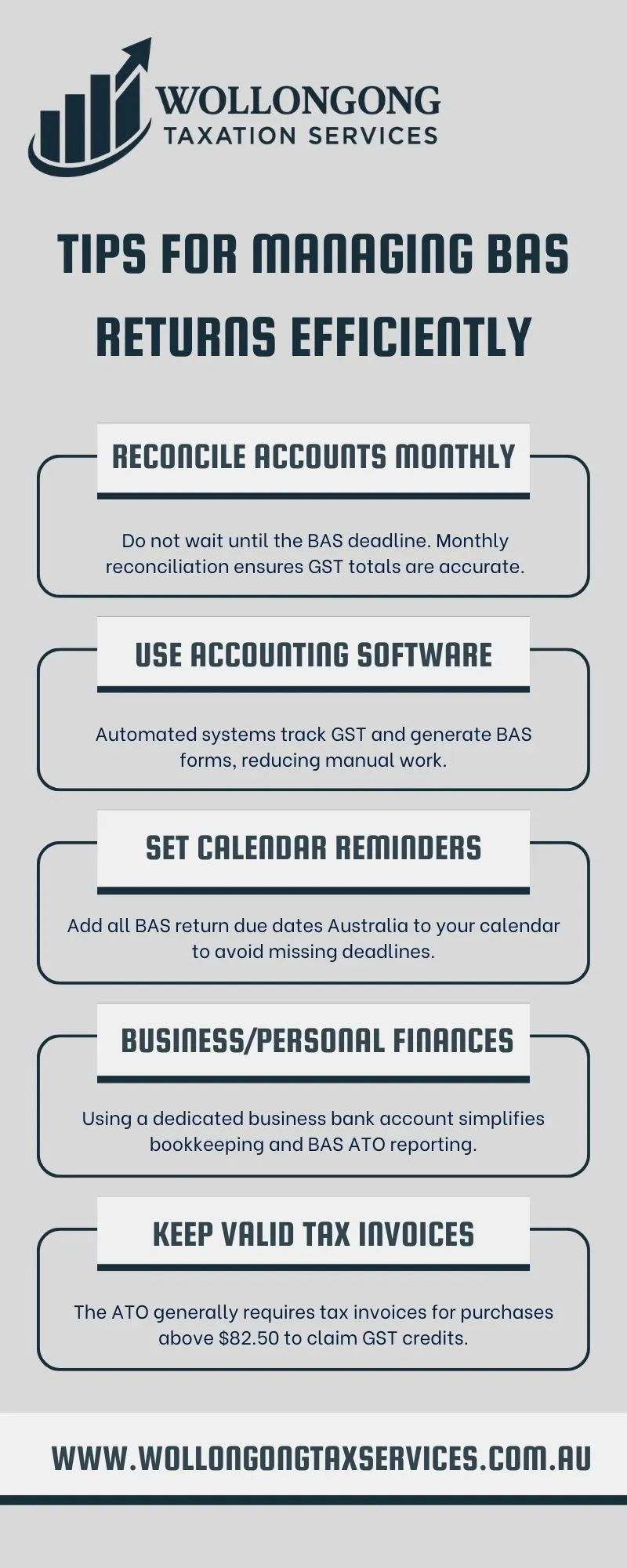
Tips for Managing BAS Returns Efficiently
Conclusion
Understanding BAS returns is essential for every Australian business registered for GST. The BAS ATO reporting system allows businesses to report GST, PAYG withholding, and other tax obligations in a single form.
While the process may initially appear complex, learning how BAS lodgement works, understanding BAS return due dates Australia, and knowing how to calculate GST on BAS can make compliance far easier. Reliable record-keeping and accounting software also help reduce reporting errors.
Most importantly, businesses should follow official ATO guidance and maintain accurate financial records to ensure their BAS form submissions remain accurate and compliant.
FAQs
What information is required to complete a BAS form?
A BAS form requires details about GST collected on sales, GST credits on purchases, PAYG withholding, PAYG instalments, and other applicable taxes during the reporting period.
Can BAS lodgement be done online in Australia?
Yes. Most businesses complete BAS lodgement online using ATO Online Services, accounting software like Xero or MYOB, or through a registered BAS agent authorised by the Tax Practitioners Board.
Can a business receive a GST refund through BAS returns?
Yes. If GST credits on purchases exceed GST collected on sales during the reporting period, the business may receive a refund after submitting BAS returns to the ATO.
What happens if mistakes are found after submitting BAS?
If errors are discovered after submitting BAS returns, businesses can correct them in a future BAS statement or request an amendment through the ATO depending on the size and nature of the mistake.
How long does the ATO take to process BAS returns?
According to ATO guidance, most BAS returns submitted electronically are processed within a few business days, while refunds may take slightly longer depending on verification checks.
Can businesses change their BAS reporting frequency?
Yes. The ATO may allow businesses to change BAS reporting frequency between monthly, quarterly, or annually depending on turnover thresholds, GST registration status, and compliance history.