
Payroll taxes are one of the most complex and closely regulated obligations Australian employers face. Beyond simply paying staff, businesses must calculate payroll wages correctly, withhold PAYG withholding amounts, meet superannuation guarantee requirements, and determine whether they are liable for payroll tax at a state or territory level. Errors can lead to penalties, interest charges, and audits that consume time and resources.
Payroll tax in Australia is a state and territory tax paid by employers whose total taxable wages exceed the relevant threshold. It is separate from PAYG withholding and superannuation and is calculated monthly or annually, depending on the state.
What Are Payroll Taxes in Australia?
The term payroll taxes in Australia is often used broadly, but it actually covers several different obligations:
- PAYG withholding, where employers withhold income tax from employee wages and remit it to the ATO.
- Payroll tax, a state and territory tax based on total taxable wages, once a business exceeds a threshold.
- Superannuation guarantee contributions, which employers must pay on top of wages.
According to the Australian Taxation Office, PAYG withholding is part of the federal income tax system and applies to most employee payments, including salaries, wages, bonuses, and allowances. Payroll tax, by contrast, is administered separately by each state and territory revenue office and only applies if total wages exceed the relevant threshold.
Understanding this distinction is essential because businesses often comply fully with PAYG withholding but overlook payroll tax liabilities, particularly when they grow, hire contractors, or operate across multiple states.
Understanding Payroll Tax
Payroll tax is not a federal tax administered by the ATO; it’s collected by individual state and territory revenue offices on employers whose Australian wages exceed the relevant threshold.
How Payroll Tax Works
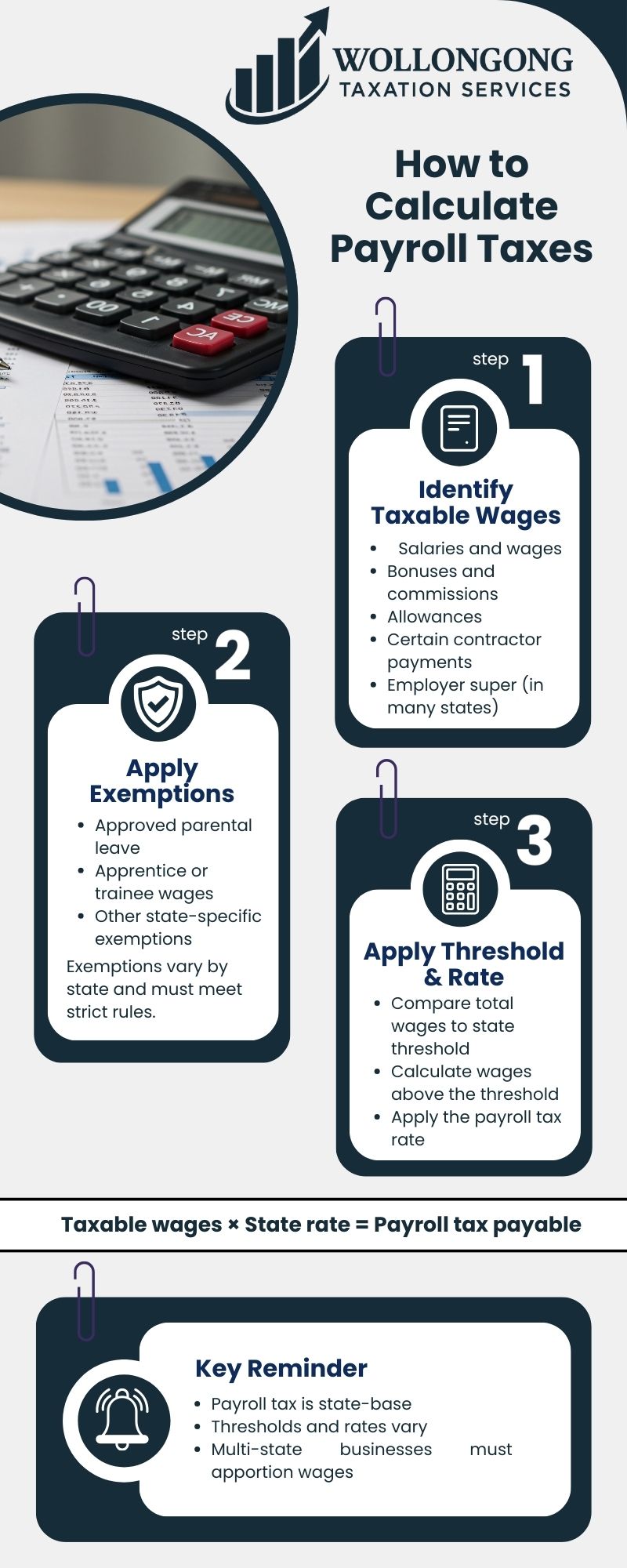
Each state or territory sets:
- A tax-free threshold (annual or monthly),
- A tax rate on wages above that threshold, and
- Rules for apportioning wages if your business operates in multiple jurisdictions.
If your total Australian taxable wages exceed the threshold in a financial year (or if monthly wages exceed the monthly threshold), you must register for payroll tax in that state.
Payroll Tax Rates and Thresholds
Here’s a snapshot of current payroll tax obligations (2025–26 financial year):
- New South Wales: 5.45% on wages above $1,200,000 annual threshold.
- Queensland: 4.75% (or 4.95% for larger employers over certain wage bands).
- Victoria: 4.85% above $1,000,000.
- Western Australia: 5.5% above $1,000,000 (with diminishing thresholds).
- South Australia: 4.95% above $1,500,000.
These figures vary by jurisdiction and can change with state budgets. Employers with operations in multiple states must apportion total wages and may need to register in multiple jurisdictions.
Who Must Pay Payroll Tax
You must pay payroll tax if your total Australian wages exceed the threshold for the state or territory in which you operate. Wages include salary, wages, allowances, bonuses, and, in most cases, employer superannuation contributions. Employers are required to register for payroll tax in each state or territory where they have a taxable presence, with wages apportioned if employees work across multiple jurisdictions.
For groups of related companies, taxable wages may be aggregated. A common mistake is to assume that payroll tax only applies in the state where employees are located. In fact, total Australian wages drive registration and liability, with apportionment where necessary.
Key Components of the Australian Payroll System
Payroll Wages
Payroll wages include more than just base salary. State revenue authorities consistently note that taxable wages may include:
- Salaries and wages
- Overtime
- Bonuses and commissions
- Allowances
- Certain contractor payments
- Fringe benefits, in some cases
Revenue NSW and other state bodies emphasise that misclassifying payments is a common cause of payroll tax underpayment.
Ordinary Time Earnings
Ordinary time earnings (OTE) are a defined subset of earnings used primarily to calculate superannuation guarantee contributions. According to the ATO, OTE generally includes earnings for ordinary hours of work, such as base pay and some allowances, but excludes overtime.
While OTE is not the same as payroll tax wages, confusion between the two concepts can lead to incorrect calculations, especially in businesses with complex pay structures.
Superannuation Guarantee
Under federal law, employers must pay super guarantee contributions at the legislated rate on eligible earnings. The ATO provides detailed guidance on what counts as eligible earnings and how contributions must be reported and paid.
Some states include superannuation contributions as part of taxable wages for payroll tax purposes, which means employers must consider superannuation twice: once as a federal obligation and again when assessing payroll tax liability.
PAYG Withholding Explained
The Pay As You Go (PAYG) withholding system is how employers withhold income tax from employee wages throughout the year. Unlike payroll tax (which employers pay on wages), PAYG withholding ensures that employees pay their income tax in installments as they earn.
Employers must register for PAYG withholding before paying their first employee and withhold tax based on the ATO’s tax tables.
How PAYG Withholding Works
Each pay period, employers calculate how much tax to withhold from gross wages based on:
- The employee’s income
- Whether they claim the tax-free threshold
- Applicable tax offsets, Medicare levy, HELP/HECS debts
- The amount withheld is then reported and remitted to the ATO.
PAYG withholding is separate from employer superannuation obligations (the super guarantee) and from payroll tax.
PAYG Withholding vs Payroll Tax
Payroll tax and PAYG withholding are often confused, but they serve different purposes and are paid by different parties, as shown below.
| Aspect | Payroll Tax | PAYG Withholding |
| Type of tax | State or territory tax | Federal tax |
| Who pays it | Employer | Employee (withheld by employer) |
| Applies to | Total wages paid by the business | Individual employee wages |
| Threshold | Yes, varies by state | No threshold |
| Tax authority | State revenue offices | Australian Taxation Office (ATO) |
| Reporting | Monthly and annual state payroll tax returns | Included in Single Touch Payroll (STP) and BAS |
| Purpose | Revenue based on employer wage size | Prepayment of employee income tax |
Understanding the difference matters. Payroll tax is a business cost once wage thresholds are exceeded, while PAYG is simply withheld on behalf of employees and passed on to the ATO.
How to Calculate Payroll Taxes Accurately
Payroll Deductions Explained
Payroll deductions primarily relate to PAYG withholding, but may also include:
- Salary sacrifice arrangements
- Court-ordered deductions
- Employee contributions to benefits
The ATO provides detailed PAYG withholding tables and formulas that employers must use. Using outdated tables is a common error highlighted in ATO compliance reports.
From a payroll tax perspective, deductions from employee wages generally do not reduce taxable wages unless specifically allowed under state legislation.
Compliance and Reporting Requirements
Single Touch Payroll (STP)
Single Touch Payroll is a federal reporting system administered by the ATO. Under STP, employers report payroll information, including gross wages, PAYG withholding, and superannuation liability, each time they pay employees.
According to the ATO guidance, STP reporting does not replace payroll tax obligations. However, state revenue authorities increasingly use STP data to identify potential payroll tax non-compliance. Maintaining accurate records and reconciling payroll data regularly reduces audit risk and penalties.
Payroll Tax Return and Lodgement Requirements
Most states require employers to lodge payroll tax returns monthly and reconcile annually. Even if no tax is payable, a nil return may still be required. Revenue authorities consistently note that late or incorrect payroll tax returns can attract penalties and interest. Some jurisdictions offer voluntary disclosure programs that reduce penalties if errors are identified and corrected proactively.
According to the Revenue NSW and the State Revenue Office Victoria, record-keeping is critical. Employers must retain payroll records for several years and be able to substantiate wage calculations during audits.
Common Compliance Risks and Penalties
Research from professional accounting bodies identifies several recurring payroll tax risks:
- Incorrect treatment of contractors
- Failure to apply grouping rules
- Misclassification of allowances
- Inconsistent data between STP and payroll tax returns
State revenue audits often focus on contractors, as many payments that are not subject to PAYG withholding may still be taxable for payroll tax purposes. Industry associations stress that contractor arrangements should be reviewed regularly against current legislation.
Conclusion
Payroll tax is a significant employer obligation in Australia, with implications for compliance, reporting, and financial planning. It’s calculated based on state and territory rules that vary widely, and managing it effectively requires a clear understanding of your wages, thresholds, and reporting obligations. PAYG withholding and STP reporting are separate but related responsibilities.
Staying updated with the ATO’s guidance and state revenue office requirements and using compliant payroll systems will make compliance easier. For complex situations or multi-state operations, consider working with a qualified payroll professional or tax advisor to ensure accuracy and compliance.
Need help managing your payroll tax obligations? Contact Wollongong Tax Services for expert guidance on payroll compliance, bookkeeping, and taxation services.
Related Articles
Tax Laws in Australia: Guide for Residents & Non-Residents
Payday Super 2026: What Australian Employers Need to Know
FAQs
How do I know if my business needs to pay payroll tax?
According to Revenue NSW, payroll tax applies once your total Australian wages exceed the relevant state threshold. Research from state revenue offices indicates that grouped businesses must aggregate wages across related entities when assessing liability.
What happens if I lodge my payroll tax return late?
State revenue authorities advise that late payroll tax return lodgement can result in penalties and interest charges. In serious cases, retrospective audits may apply.
Does Single Touch Payroll replace payroll tax reporting?
No. According to the ATO, Single Touch Payroll does not replace payroll tax return obligations. Employers must still lodge payroll tax returns separately with state revenue offices.
Does PAYG withholding affect payroll tax calculations?
The ATO explains that PAYG withholding is separate from payroll tax. However, the gross wages reported for PAYG purposes are often the starting point for payroll tax calculations, subject to state-specific adjustments.