Small Business Accounting Australia refers to the systems, records, and financial processes that Australian businesses use to track income, manage expenses, meet tax obligations, and report financial performance. For sole traders, startups, and growing SMEs, strong accounting practices are essential not only for understanding profitability but also for staying compliant with regulations enforced by the Australian Taxation Office. This guide explains how accounting works for small businesses in Australia, including legal requirements, financial records, accounting systems, and tax responsibilities.
What Is Small Business Accounting in Australia?
Small Business Accounting Australia refers to the structured process of recording, organising, analysing, and reporting a business’s financial activity. It helps Australian businesses track profits, manage costs, meet tax obligations, and prepare financial statements.
In Australia, accounting systems must align with regulatory expectations from agencies like the Australian Taxation Office and financial reporting frameworks overseen by the Australian Accounting Standards Board. Understanding Australian accounting standards, including how AASB and IFRS frameworks apply, is particularly relevant for businesses preparing formal financial statements.
Small business accounting generally includes:
- Tracking income and revenue
- Recording operating expenses
- Managing payroll and superannuation
- Preparing financial statements
- Supporting tax lodgements and BAS reporting
These processes create the small business financial records required for compliance and decision-making.
Why Small Business Accounting Matters for Australian Businesses
Effective accounting is fundamental to business stability and growth. For Australian small businesses, it serves several critical functions.
Better financial decision-making
Accurate accounting helps owners understand revenue trends, profit margins, and operating costs. With reliable financial data, business owners can make informed decisions about hiring, expansion, pricing, and investment.
According to data from the Australian Small Business and Family Enterprise Ombudsman , small businesses represent more than 97% of Australian enterprises, highlighting the importance of financial management practices that support sustainability.
ATO compliance and audit readiness
Businesses must maintain accurate small business financial records to demonstrate compliance with tax laws. The Australian Taxation Office requires businesses to keep detailed financial documentation supporting income, expenses, GST, and employee payments.
Failure to maintain proper records can lead to penalties or increased audit risk. Businesses that want to understand what triggers ATO scrutiny and how to reduce exposure can benefit from reviewing ATO tax audit guide.
Cash flow visibility and planning
Strong accounting systems provide real-time insights into cash flow, allowing businesses to forecast future expenses and revenue cycles.
Legal obligations and penalty avoidance
Australian companies must meet financial reporting expectations under regulations overseen by the Australian Securities and Investments Commission. Proper accounting helps businesses comply with those requirements and avoid regulatory penalties.
Small Business Accounting Requirements in Australia
Australian businesses must follow several financial and regulatory requirements when managing their accounting systems.
ATO legal requirements and registration obligations
Businesses operating in Australia must register for relevant tax identifiers, such as:
- Australian Business Number (ABN)
- Tax File Number (TFN)
- Goods and Services Tax (GST) registration when required
According to the Australian Taxation Office, businesses must maintain complete financial documentation to support tax returns and BAS reporting.
Financial record-keeping rules
Businesses must maintain detailed small business financial records, including:
- Income and sales documentation
- Expense and purchase receipts
- Payroll and superannuation records
- Asset purchases and depreciation
ATO guidelines explain that records must be accurate, complete, and accessible.
GST and BAS reporting requirements
Businesses with annual turnover exceeding $75,000 must register for GST and submit Business Activity Statements (BAS). These reports summarise GST collected, GST paid, PAYG withholding, and other tax obligations.
Payroll and superannuation obligations
Employers must:
- Withhold PAYG tax from wages
- Pay employee superannuation contributions
From 2026, new payday super rules require employers to pay superannuation contributions on the same day as wages, which has significant implications for payroll processes and cash flow management.
Audit and compliance expectations
Businesses may be subject to compliance checks or audits if financial records appear inconsistent or incomplete.
Australian accounting standards framework
Financial reporting rules are guided by standards from the Australian Accounting Standards Board and corporate governance regulations overseen by the Australian Securities and Investments Commission.
ATO Record-Keeping for Small Business
Maintaining accurate records is a central requirement of ATO record-keeping for small business compliance.
Records the ATO requires
According to the Australian Taxation Office, businesses must keep documents that explain all financial transactions, including:
- Sales and income records
- Expense receipts and invoices
- Bank statements
- Payroll documentation
- GST records
- Asset purchases and depreciation schedules
ATO guidance states that records must be detailed enough to verify the accuracy of tax returns.
Minimum record retention period
Australian businesses must keep financial records for at least five years after the relevant transaction or tax return. This rule ensures the ATO can verify past returns during audits or compliance reviews.
Digital vs paper record-keeping
The ATO accepts both digital and paper records, provided they are:
- Accurate
- Complete
- Readily accessible
Many businesses now use digital systems as part of their small business accounting system because they automate record storage and simplify compliance.
Common record-keeping mistakes
Research and professional guidance from accounting bodies such as CPA Australia frequently highlight common issues:
- Missing receipts or invoices
- Inconsistent bookkeeping
- Mixing personal and business finances
- Losing records due to poor storage systems
These problems often arise when businesses lack structured accounting systems. Understanding what bookkeeping involves and how it differs from accounting more broadly can help business owners set up the right processes from the start.
Penalties for poor record management
Failure to maintain proper records can lead to:
- Administrative penalties
- Tax return adjustments
- Increased audit scrutiny
According to ATO compliance guidelines, incomplete financial documentation can affect a business’s ability to substantiate deductions or income declarations.
Essential Small Business Financial Records to Maintain
To maintain compliant small business financial records, businesses must track several key categories of financial data.
Income and sales records
Businesses must record all sources of revenue, including:
- Cash sales
- Online payments
- Bank transfers
- Marketplace transactions
Accurate income records ensure correct tax calculations and GST reporting.
Expense and purchase records
Expenses must be documented to support tax deductions. These may include:
- Office supplies
- Utilities
- Marketing costs
- Equipment purchases
- Travel expenses
Maintaining receipts and invoices helps support small business tax accounting deductions.
Payroll and employee records
If a business has employees, it must maintain payroll documentation, including:
- Wage payments
- PAYG withholding records
- Superannuation contributions
According to the Australian Taxation Office, payroll documentation must be retained to demonstrate compliance with employer obligations. Businesses with staff should also be across their broader payroll tax rules and obligations to avoid compliance gaps.
Bank statements and cash flow records
Bank records are critical for reconciling income and expenses. These documents help businesses:
- Monitor cash flow
- Detect errors or fraud
- Verify accounting records
Many small business accounting systems integrate directly with bank feeds to automate this process.
Asset and depreciation records
Businesses must track major asset purchases such as vehicles, equipment, and technology.
These records should include:
- Purchase cost
- Date of acquisition
- Depreciation schedules
Depreciation documentation ensures accurate financial reporting and tax treatment.
Small Business Accounting Systems in Australia
What an accounting system does
A small business accounting system is the software or process used to record, organise, and analyse financial transactions.
These systems help businesses:
- Track income and expenses
- Generate financial reports
- Prepare BAS and tax returns
- Maintain small business financial records
Manual vs digital accounting
Some small businesses still use spreadsheets or manual bookkeeping systems.
Manual accounting advantages
- Low cost
- Simple setup
Limitations
- Greater risk of errors
- Time-consuming record management
- Limited financial reporting capabilities
Cloud accounting software
Many Australian businesses now use cloud accounting platforms to automate financial processes.
Benefits include:
- Real-time financial data
- Automatic bank feeds
- Invoice generation
- GST tracking
Professional accounting bodies, including CPA Australia, frequently recommend digital accounting tools to improve accuracy and efficiency.
Features to look for
An effective small business accounting system should include:
- GST tracking
- BAS reporting tools
- Automated invoicing
- Expense categorisation
- Financial reporting dashboards
- Bank integration
ATO-compliant software
Some accounting software integrates directly with ATO systems to streamline tax reporting. According to the Australian Taxation Office, digital record-keeping solutions can simplify compliance and reduce reporting errors.
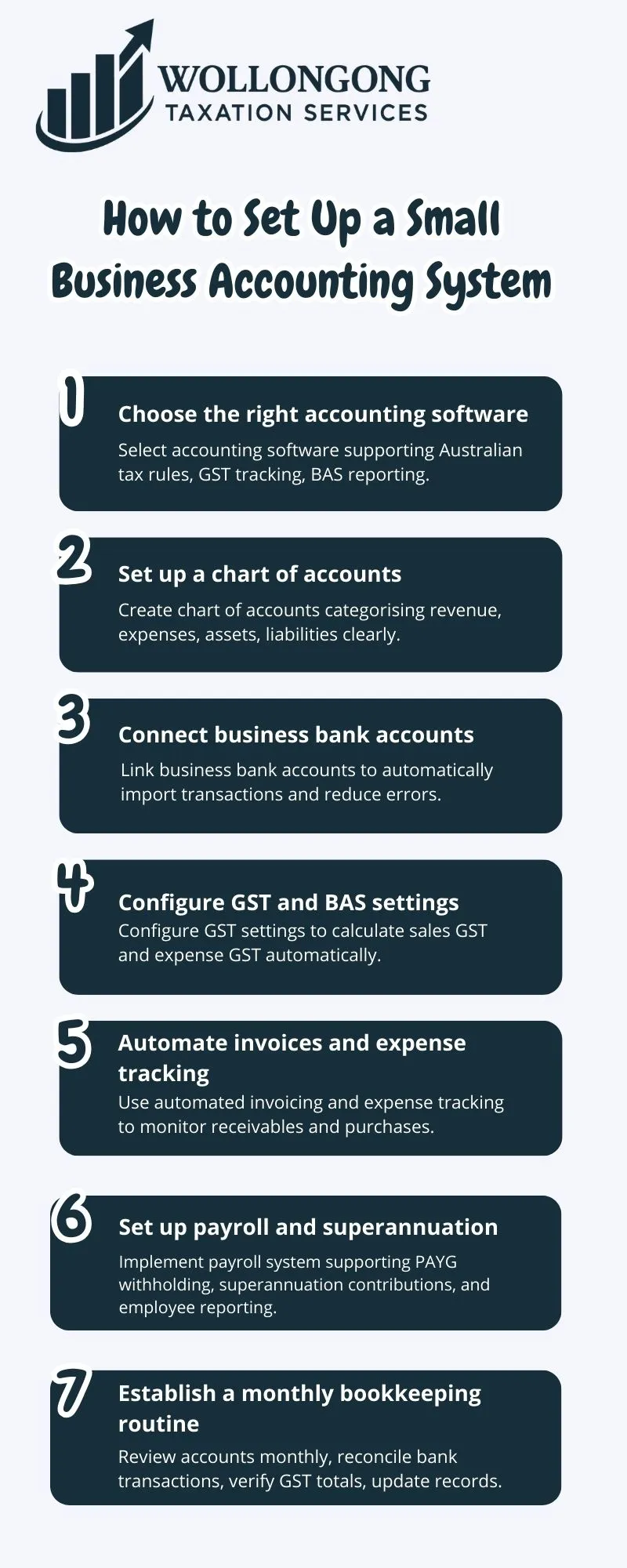
How to Set Up a Small Business Accounting System
Small Business Tax Accounting in Australia
Small business tax accounting involves managing tax obligations related to income tax, GST, payroll taxes, and deductions.
Income tax obligations
Most Australian businesses must report income through annual tax returns.
Tax obligations depend on the business structure:
- Sole traders report income through personal tax returns
- Companies lodge company tax returns
- Partnerships distribute income among partners and have separate reporting requirements under a partnership tax return.
GST obligations and thresholds
Businesses must register for GST if their annual turnover exceeds $75,000.
According to the Australian Taxation Office, registered businesses must:
- Charge GST on taxable sales
- Lodge Business Activity Statements (BAS)
- Maintain GST documentation
BAS reporting requirements
BAS submissions summarise:
- GST collected and paid
- PAYG withholding
- PAYG instalments
Businesses may lodge BAS monthly, quarterly, or annually, depending on turnover. Being aware of ATO tax deadlines for BAS and other lodgements helps avoid late penalties.
PAYG withholding
Employers must withhold tax from employee wages and report payments to the ATO.
Tax deductions and allowable expenses
Many operational expenses may be deductible under Australian tax rules.
Common deductible categories include:
- Office rent
- Business travel
- Equipment purchases
- Professional services
- Depreciation of assets
Accurate small business financial records are essential for supporting these deductions.
Tips to Improve Small Business Financial Management
Effective financial management goes beyond compliance.
Automate financial processes
Modern small business accounting systems automate tasks like invoicing, transaction categorisation, and bank reconciliation.
Review financial reports monthly
Regular review of financial reports helps identify trends early and avoid cash flow problems.
Maintain cash flow forecasts
Cash flow projections help businesses prepare for seasonal revenue changes or unexpected expenses.
Stay updated with ATO rule changes
Tax rules and compliance requirements change regularly. Businesses should monitor updates from the Australian Taxation Office.
Use financial data for decision-making
Financial insights from accounting reports can guide pricing strategies, hiring decisions, and expansion planning.
Conclusion
Understanding Small Business Accounting Australia is essential for maintaining compliance, improving financial visibility, and supporting long-term business growth. By maintaining accurate small business financial records, implementing a reliable small business accounting system, and following ATO record-keeping for small business guidelines, Australian businesses can meet regulatory requirements while making informed financial decisions. Effective small business tax accounting also helps reduce errors, avoid penalties, and optimise tax outcomes.
Need help with Small Business Accounting Australia or ATO record-keeping for small business? Visit Wollongong Tax Services for expert support with small business tax accounting and compliant financial records.
FAQs
Do small businesses in Australia need separate business bank accounts for accounting?
Yes. Financial experts recommend separating personal and business accounts to maintain accurate small business financial records, simplify small business tax accounting, and ensure clearer reporting for ATO compliance.
How long should financial records be kept for ATO compliance?
ATO guidelines require businesses to retain financial records for at least five years after the transaction or tax return. These records must be accurate, accessible, and capable of verifying financial activity.
What financial reports should small businesses review monthly?
Businesses should review profit and loss statements, cash flow reports, and expense summaries monthly. These reports help monitor performance, manage costs, and maintain accurate small business financial records.
Is bookkeeping enough for managing small business accounting in Australia?
Bookkeeping records daily transactions, but accounting analyses those records for financial planning, reporting, and small business tax accounting. Both functions are important for maintaining compliant financial management.
What happens if a business fails to meet ATO record-keeping requirements?
Businesses that fail to maintain accurate financial records may face administrative penalties, tax return adjustments, or increased audit scrutiny from the ATO.
Why is cash flow tracking important for small businesses?
Cash flow tracking helps businesses monitor incoming and outgoing funds, identify financial gaps, manage expenses, and ensure there is enough liquidity to meet operational and tax obligations.